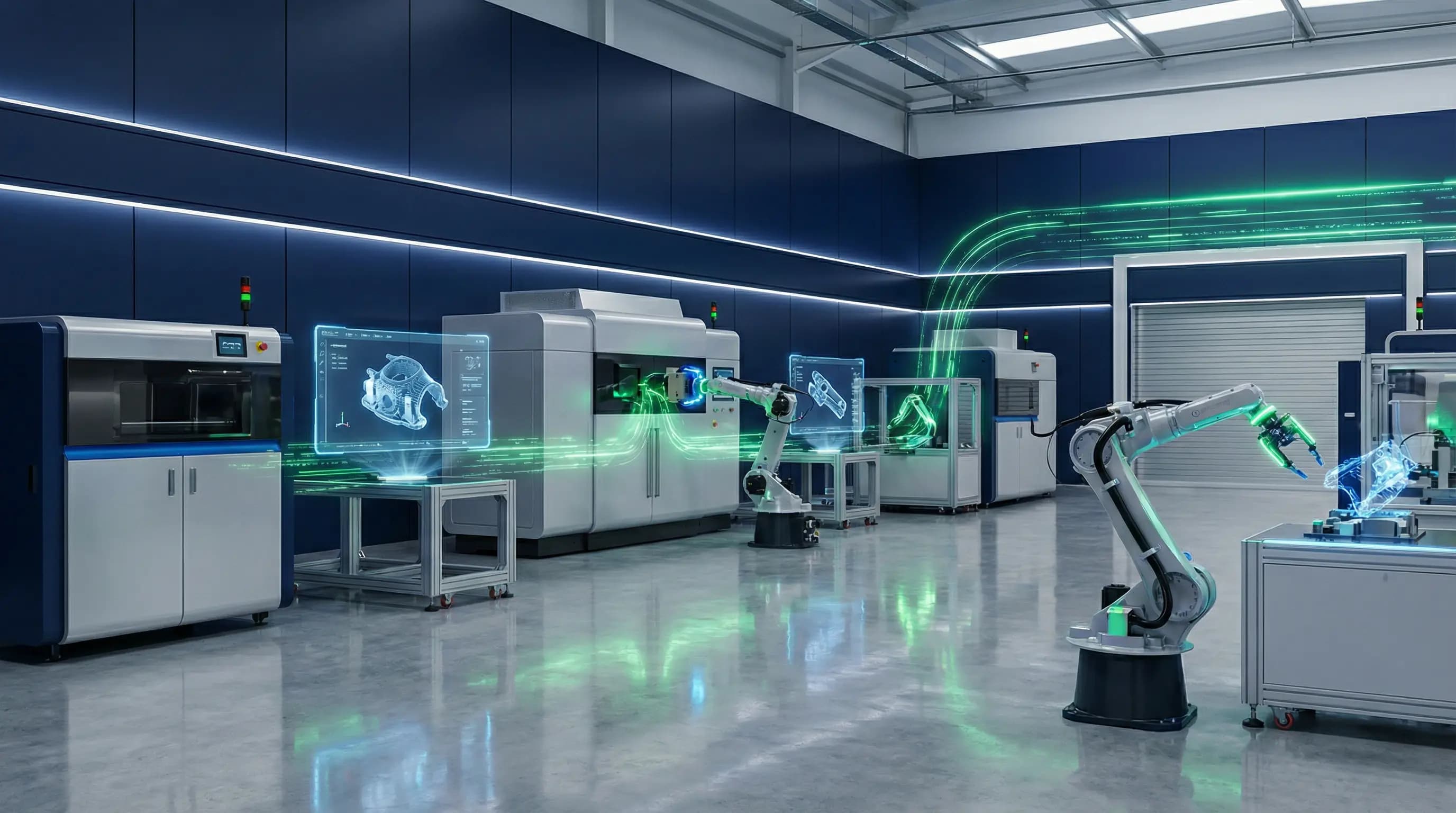
2026 is redefining digital fabrication: GenAI-assisted design inside CAD, digital twins for predictive maintenance, and additive manufacturing moving deeper into production—especially in metals. Here's what matters now.
Digital fabrication in 2026 is becoming more connected, more intelligent, and more production-focused. The most competitive teams are combining strong CAD with fast iteration, reliable process control, and better data discipline.
A key shift is the practical use of AI in design workflows. Generative AI is increasingly used for early concept exploration, geometry alternatives, and optimisation. The teams winning are pairing that speed with strong DFM (design for manufacturing): tolerances, tool access, fixturing, and realistic material behaviour.
Digital twins are also moving from buzzword to tool. More shops are using sensor data (vibration, temperature, spindle load, print telemetry) to detect drift, predict failures, and improve repeatability. In real terms: less downtime, better quality, fewer surprises.
Additive manufacturing continues its move from prototyping into manufacturing. In particular, metal AM is being pushed toward higher-volume pathways, while inspection and QA become the bottleneck for production-grade adoption.
Finally, the software stack is tightening. Shops are increasingly aligning machine data with production planning and decision-making. If you can see what's happening in near real-time, you can schedule better, maintain better, and deliver faster.
For innovation hubs and fabrication labs in Africa, this is an advantage: you don't need the world's biggest factory to compete. You need a strong pipeline — SolidWorks-driven design, reliable fabrication capability, fast iteration, and documented quality processes.
Related Articles
Ready to build your next prototype or production run?
Get a fast quote for CNC machining, fabrication, 3D printing, or IoT integration — with SolidWorks-driven design support.